
Chapter 4. The China Connection
Draft of April 6, 2023
Text word count: 6,411
Chapter 4. The China Connection
 In January and again in March 2000, I traveled to China to launch an education-centric e-commerce business model designed to provide an exclusive Internet portal into China for education. The initial reach was 235 million schoolchildren, their families and their communities. Nokia committed $150 million with another $100 million available as we met performance benchmarks that Nokia was confident could be met.[1]
In October 2003, former Youthstream Media Networks President Ben Bassi told Jeff that Youthstream put the initial value of the joint venture at $300 million. My stake was 30 percent of the JV for providing the concept and the strategy, designing the financial structure, raising the money, and ensuring that the right people were present to close the deal—as we did.
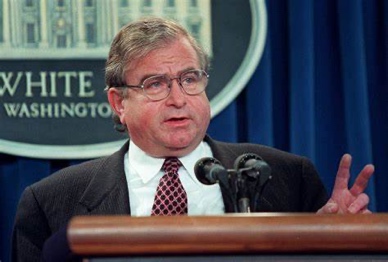
Rather than allow the agreed-to transaction to proceed (and me get paid), Youthstream Chairman Harlan Peltz and the Youthstream board shuttered a large publicly traded U.S. company. As elsewhere, the trail led back to Israel, its lobby and a transnational (predominantly Jewish) criminal syndicate. Just prior to Ben and I departing for Beijing, Harlan described for us his relationship since childhood with “dear friend” Sandy Berger, then serving as National Security Advisor for President Bill Clinton. Determined to prove to me the familiarity of their relationship, he reached for his phone to call Berger on his private line so I could speak with him directly. I declined.
 Our meeting in Manhattan occurred 20 months prior to the provocation of 9/11 at a time when that crisis was being pre-staged. In April 2005, Berger plead guilty to his October 2003 theft and destruction of documents from the National Archives detailing what President Clinton was told about terrorist threats—reliant on Berger’s advice.[2] As the Clinton representative to the 9/11 Commission investigating those attacks, Berger was tasked with assessing his own advice by reviewing archived presidential papers.[3]
Harlan Peltz, Berger’s lifelong pal, undermined our agreed-to hybrid model for e-commerce in China. The model was designed to generate more value than the BATs—as of April 5, 2023: Baidu ($50 billion), Alibaba Group Holding ($256 billion), and Tencent ($463 billion). With our approach, the bulk of the equity would be captured for community and a portion of profits would fund education and vocational training in what was poised to become the world’s largest economy.
That strategy also would have served as a global proof-of-concept for a hybrid business model that my father pioneered in Latin America in the 1940s to counter what he described as the rapacious greed of capitalism—a primary rationale for communism. By design, a bottom-up inclusive “accountable capitalism” would by now have captured trillions of dollars in financial value for communities throughout China while relieving the fiscal burden of education. And, in the process, demonstrating how a non-ideological future is desirable and achievable.
Had our education-centric approach to business emerged in 2000 in the world’s most populous nation, it would have countered the subsequent oligarch-ization of China. In 2015, the “communist” Peoples Republic of China overtook “capitalist” America as home to the most dollar billionaires with 596 versus 563 in the U.S. [4] By mid-2017, China was minting two billionaires per week for a total of 647 billionaires.[5] The Huron Rich List 2022 reported 901 billionaires in China. Forbes April 2023 rich list tallied 735 billionaires in the U.S.
 Even in 2000, it was clear that convergence on a single model for information technology was only a matter of time. With China’s weak commercial infrastructure, it was also clear that e-commerce would emerge—as it has—as a major market. Instead of a model designed to capture the value of these network monopolies for a broad base of households, China’s Internet market space is now dominated by the “BATs”.

 Baidu is the dominant search engine ($51 billion market cap). Alibaba controls 80% of China’s e-commerce (valued at $266 billion). Tencent, the gaming, social media and telecom giant, had a market value of $471 billion as of April 9, 2023. By the first quarter 2023, its WeChat app had more than 1.2 billion monthly active users, including 78% of people in China ages 18-64 (including 1.5 million active users in the U.S.). The BATs are now China’s largest private companies by market capitalization.
Rather than launch new technologies with a business model designed for inclusion, the Beijing version of the “Washington consensus” created a handful of multi-billionaires, ensuring a fast-widening inequality with no solution in sight. With few alternatives, the BATs dominance in e-commerce made them, in effect, a taxing authority able to levy fees for online access.
As in the U.S. and worldwide, the Chinese model creates wealth for shareholders by monetizing access to users’ attention spans. And by providing advertisers an opportunity to change the behavior of those users reliant on algorithms that ongoingly adapt to that usage.
[See 2020 documentary, The Social Dilemma featuring tech experts alarmed at the dangers of their own AI-driven creations. Polarization increases along with loneliness, teen suicide, extremism and other social ills. Fake news spreads 6X faster than truth. See the online trailer.]
Rather than a model that funds education as part of doing business, China mimicked the West at the urging of the same consensus-model advocates who advised Russia’s post-Soviet transition to its oligarch-ization. In 1982, Deng Xiaoping described their model as “socialism with Chinese characteristics”. In March 2022, the model became “Xi Jinping Thought on Socialism with Chinese Characteristics for a New Era” with the goal of building a “moderately prosperous society.”
Rockefellers in China
Prior to traveling to Beijing, I had no idea the Rockefeller name is one of the most respected in China. On my arrival, when I saw the security detail assigned to me, I protested, explaining I am related to the family but not their wealth. I told the Minister in charge of our arrangements that if I wrote a check for $200,000, it would bounce even with Nokia and YouthStream backing my plan.
The official thanked me for my candor and explained why so many Chinese remain grateful for the family’s generosity in helping educate generations of Chinese with no expectation of recognition or reward. My hosts took me to see materials confirming that my ancestors’ anonymous grants in support of science, medical research and higher education helped train many of China’s professionals over the past century. In the presence of other senior officials and Dr. Dennis Lou (see below), the Minister said,
“Mr. Rockefeller, we know how much is in your account, who your father is and that you are your own person. We must protect your name. Your great-grandfather and his brother William gave to China much of their kerosene wealth in 1898. They had three conditions for the gift. First, no family member could benefit commercially as a result of the gift. Second, the gift was to remain anonymous with nearly all of China aware of what your family did for us when they gave back more than any Westerner who has ever come to China.
They were the first to give back more than they took. Third, we never had to praise Jesus to get the money—with both men sharing that they taught Sunday school. Your family has the same respect as our greatest thinkers, including Confucius, which is why we cannot let anything happen to you as our guest.”
As the meeting concluded and we walked out, the Minister put his hand on my back and, with his translator walking in step with us, told me that my father was the only other Rockefeller made aware of this gift in detail. He said, “The only Rockefellers who came to China to work were you and your father. The others had lavish dinner parties and took lots of photographs with our leaders.”
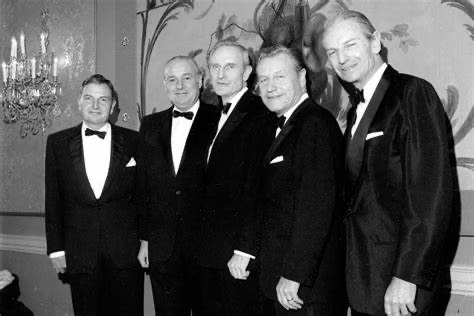
It took me a few days to process that meeting, hoping that someday one of my grandsons’ great-grandsons or daughters would be working to make the world a better place and discover what I was doing much as I did that day when I discovered what was done for the people of China by John D. and William.
To help China recover from their devastating Great Leap Forward (1958-60) and the even more disastrous Cultural Revolution (1966-76),[6] the five third-generation Rockefeller brothers (including my father) made a second large gift for education and vocational training, again anonymously. In combination, those family gifts topped $850 million in 2021 dollars.[7]
The generation that experienced the Cultural Revolution while in their teens and early twenties were denied an education in favor of ideology and revolutionary fervor rather than being empowered with knowledge and an opportunity to prosper from personal initiative and creativity.
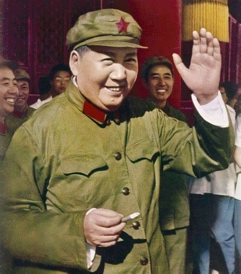
The harm inflicted on all aspects of China’s education system took decades to mend. “Experts estimate that Mao was responsible for 40 to 70 million civilian deaths in peacetime—more than Stalin and Hitler combined.”[8] One key distinction: Stalin and Hitler have been discredited whereas Mao remains a central figure in China and the Communist Party maintains tight control over education, media, and public discourse—including control of the Internet.
Liberty’s Last Line of Defense
At the urging of Dr. Glenn Olds, Dr. Dennis Lou flew to Beijing to assist me in finalizing our agreement with the Ministry of Education. I quickly found that he remained revered for his design of the vocational training program that helped China recover from the Cultural Revolution. On his arrival in Beijing, he came to the meeting wearing a worn jacket over a Mickey Mouse tee shirt. In a nation that reveres its elders and values their knowledge, his attire mattered not one bit. When he entered the room, everyone stood out of respect for his selfless contribution to the people of China and his reputation as an educator devoted to serving China’s best interests.
Dr. Lou provided a key historical insight based on his father’s relationship with Sun Yat-Sen, an iconic figure both in Taiwan and China where he’s known as a “pioneer of the revolution.” Dennis recalled his father’s explanation of how, at the urging of Jewish advisers, Mao Zedong,[9] the nation’s founder (aka “the great helmsman”), sought to make the military self-sufficient rather than burden the state budget.
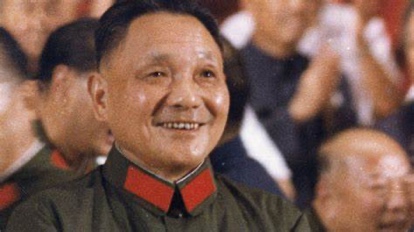
This “entrepreneurial funding” for the People’s Liberation Army (PLA) emerged in force post-Mao when, after the Cultural Revolution, Deng Xiaoping froze funding for the PLA while, to boost morale, he aligned the PLA’s interests with those promoting global capital markets and scaling today’s consensus model. By the late 1970s, the PLA had become a state within a state. With corruption rampant, a movement emerged to force the PLA to divest its commercial interests.
 While Governor of New York, my father recruited Dennis Lou and Glenn Olds to internationalize the curriculum of the 64-campus State University of New York (S.U.N.Y.). He realized in the 1960s that education would be liberty’s “last line of defense” against the duplicity of those I subsequently profiled for much of my life. Thus, the origins of NewRock’s education-centric “hybrid” business model designed to partner with universities worldwide, a design principle that dates to those Rockefeller family gifts to China for education.[10]
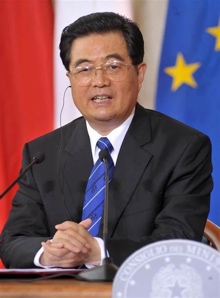
In devising the vocational training program, Dennis worked closely with Hu Jintao, then a senior provincial official, who served from 2002 to 2012 as Secretary General of the Central Committee of the Communist Party.
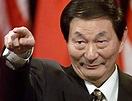
PLA bravado was on display in January 2001 when, just as U.S. Defense Secretary Robert Gates headed into a meeting with Mr. Hu, China’s air force conducted their first test flight of a stealth fighter, surprising and humiliating Mr. Hu in front of his foreign guest.[11] Dennis also mentored Zhu Rongji who from 1998 to 2003 served as the fifth premier of China, succeeding Li Peng while serving under President Jiang Zemin. Mr. Zhu sought to force the PLA to relinquish its role in businesses that routinely enriched military officers and their families.
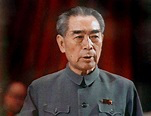
At the invitation of the President of Wuyi University, Dennis and I had dinner with the brother of the man murdered to bring Jiang Zemin to office. Mr. Zhu was a direct descendant of the first Ming  emperors. The Zhu family was very close to the family of Dennis Lou. Both their fathers worked closely with Sun Yat-Sen to bring down the corrupt Qing Dynasty. Li Peng and Mr. Zhu laid the foundation to root out the corruption that Dr. Lou described as originating with those Jewish advisers to Mao and Zhou En-lai.
According to Laura Goldman writing in Forward: “In fact, 85 to 90% of the foreigners helping the Chinese at the time of the Communist takeover were Jewish. This included the daughter of the founder of the brokerage firm Goldman Sachs, who left the comfort of her Park Avenue home to assist the Chinese.”[12]
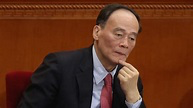
Wang Qishan joined us for that dinner. From 2012-2017, he served as the public face of an anti-corruption campaign championed by General Secretary Xi Jinpeng to root out systemic corruption (including within the PLA) that Mao’s advisers imbedded in the system when they urged funding of the military largely from PLA stakes in commercial enterprises.[13] In March 2018, Mr. Wang emerged after five months of retirement to serve for five years as vice president as Mr. Xi secured a constitutional change that ended a two-term limit on the president and the vice president.[14]
Designed-in Corruption
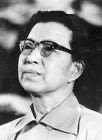
Dennis and I met with senior members of the Central Committee at Wuyi University where we discussed the possibility that the Jewish advisers to Mao and Zhou En-Lai used the Cultural Revolution to relocate the educated and cultured to the countryside, leaving the clever and uneducated who could more easily be bribed when placed in positions to displace Chinese culture and ensure that the interests of the PLA would be aligned with the interests of global capital markets.
My hosts were aware that I had been in Iraq in early 1997. They described how my visit was reported in China’s national media though without mentioning my name. They were curious to know if the same perpetrators at work in Iraq were also operating in China. I described how I knew they were, a fact confirmed by Dennis Lou. We discussed at length the influential role played by Jiang Qing, the stage name of Mao’s fourth wife, and her role in creating the Cultural Revolution and, after his death in 1976, the Gang of Four that led to the death of millions of Chinese from politically sanctioned abuse and hunger.
With the power she wielded, anyone was killed who revealed her background as what I described as a “titty bar whore.” No one disagreed with my characterization. Knowing how those I profiled routinely weaponize sex, she was likely the asset deployed to inflate Mao’s ego. Known for his fondness for adulation, he died in 1976 as an 82-year-old tyrant. In the same way that The Chosen consider themselves superior and entitled to operate above the law regardless of the impact on others, Mao told an American interviewer that he lived above “heaven and the law”.
After several lengthy discussions, we agreed that the timing of the Cultural Revolution served as a crisis-enabled means to ensure that, with globalization of the consensus model, China—with its low cost (captive) labor force—would emerge as a primary destination for transnational financial flows. With the help of consensus model-inspired trade agreements, China was certain to become a low labor cost manufacturing center for a globalized economy while enriching those long skilled at “playing the spread”—including the lucrative labor cost differential available in free versus totalitarian societies.

In 2016, when General Secretary Xi Jinping referred to himself as “commander-in-chief,” a title last used from 1949-1954, he served notice that the era of the PLA thumbing its nose at political leaders may be ending. By January 2018, more than 100 PLA generals had been forcibly retired or placed under investigation. In addition to assuming the Mao-like title of “core” leader, Mr. Xi revived a nationalist mindset linked to a more aggressive stance in foreign affairs cloaked in the phrase: “striving for achievement.”
Revived Language
In October 2016, he revived the term “comrade” when addressing colleagues,[15] In October 2017, China’s Communist Party elevated him to the same exalted status as Mao Zedong by writing his name and his ideas (“Xi Jinping Thought”) into the party constitution. In March 2018, the 19th Party Congress suspended presidential term limits, potentially making Xi a leader for life. The October 2023 20th Party Congress confirmed his hold on the power of the state.
 Beijing proved its arrival as a potential military opponent and an Information Age superpower with a January 2007 demonstration of its ability to destroy a surveillance satellite. China improved that military capability with the help of advanced gyroscopic technology provided by Loral Space & Communications, then led by CEO Bernard Schwartz, Bill Clinton’s largest political contributor.[16]

 China’s defense spending has grown at double digits every year for almost a quarter century. Beijing overtook Berlin to become the world’s fourth-largest weapons exporter. In November 2016, China highlighted its growing military capability by flying its J-20 stealth fighter in public, confirming its first-strike capability is operational. Its popular J-17 jet fighter sells for roughly half the price of comparable western aircraft. Another popular export, its CH-4 drone, is modeled on the U.S.-manufactured Reaper drone.
China’s growing military capabilities and expansion of its geographic reach heighten the potential impact of a well-timed crisis. That risk is intensified by a culture that, at least since Mao, can rely on popular support when those who readily embrace a nationalist mindset fear they face an external threat. “Maintaining a sense of peril is a part of the traditions of the Communist Party,” according to Professor Wang Wen at Renmin University in Beijing who cautions that Xi’s “…sense of peril goes deeper than recent leaders.”[17]
Though he’s demonstrated control over Party elites, control at the grassroots remains elusive. Those with a “tireless genius for crisis” could promote belief in a foreign threat, providing a catalyst to rally post-Mao China in a militarized display of support for periodic demonstrations of global leadership. Meanwhile, Xi is rebuilding the Communist Party, growing its influence and reviving its sense of mission by imbedding party units inside companies so that the Party becomes a stakeholder in business while Party activities became a daily part of peoples’ lives. For foreign joint ventures, imbedded Party organizations are described as a “bridge of enchantment.”[18]
Pre-Staged Crisis in China
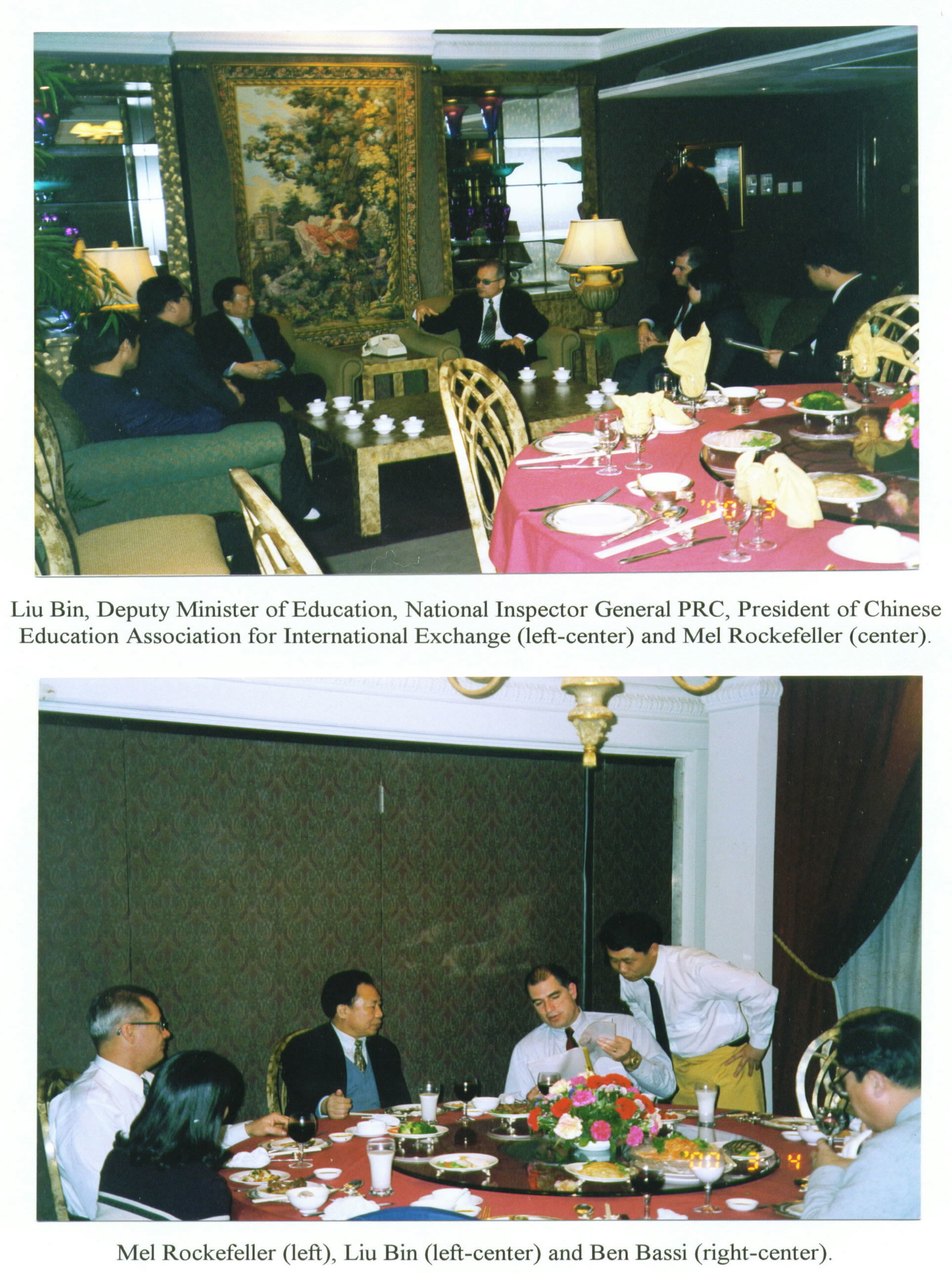
YouthStream Chairman Harlan Peltz is the son of activist investor Nelson Peltz, best known on Wall Street for his leveraged buyout of National Can acquired in 1985 with the help of junk bonds provided by Michael Milken in the Beverly Hills office of Drexel Burnham Lambert.[19] YouthStream President Ben Bassi and I briefed Harlan prior to our departure for Beijing on behalf of YouthStream. As soon as our negotiations in China concluded with a favorable outcome, Peltz contacted the Chinese party (CYC Net) and insisted that Ben lacked the authority to negotiate the very contract on which Ben and I had briefed him just prior to our departure.
 To find out what happened, Bassi called the office of YouthStream attorney Nick Howson at the Beijing office of the New York law firm of Paul, Weiss, Rifkind, Wharton & Garrison.[20] Howson told Ben he was in Shanghai. When CYC Net confirmed he was still in Beijing, Ben rushed to the Paul Weiss office to confront him. On his desk, Ben told me that he saw three recent faxes from George Soros featuring my name on the subject line that Howson quickly tried to cover up.[21]
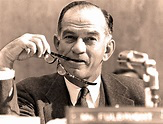
Not until several years later did I realize that Simon Rifkind battled Attorney General Robert Kennedy when President Kennedy sought to shut down Israel’s nuclear weapons program while his brother Bobby sought to force its lobby to comply with the Foreign Agents Registration Act.[22] Arkansas Senator J. William Fulbright, long-serving Chairman of the Senate Committee on Foreign Relations, enthusiastically assisted the Kennedy brothers in that dual-track effort.
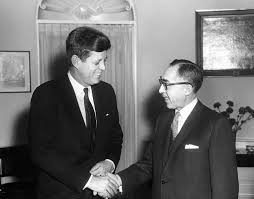
With the murder of John F. Kennedy in November 1963, the Israel lobby (then more candidly called the American Zionist Council) transformed itself—with the help of Simon Rifkind—into the American Israel Public Affairs Committee (AIPAC), a key component of the expansive Israel lobby with 600-plus affiliates. Kennedy successor Lyndon B. Johnson shut down both Kennedy initiatives.[23]

Soon thereafter, former Irgun operative Mathilde Krum stuck up an affair with LBJ such that she was ‘servicing’ him in the White House the night that Tel Aviv launched its long-planned June 1967 land grab, since marketed as the defensive, even “heroic” Six-Day War.
We anticipated a Set-Up
An experienced high-tech executive, Ben Bassi had previously served as vice-president for business development at Lycos, Inc., known on Wall Street as “the fastest initial public offering in the history of the NASDAQ.” He then served as vice-president for sales at Firefly Network, Inc. when it morphed into Microsoft Passport. He was surprised to find that events in China unfolded just as I anticipated when Israeli interests undermined our agreed-to deal—led by Harlan Peltz.
That’s why Glenn Olds and I had devised a backup plan to negotiate an agreement directly with the Education Ministry should Sandy Berger’s life-long friend intervene, as he did. I expected interference when he urged that I speak on the phone with Berger. That was a “tell” and a typical display of the arrogance I routinely encountered whenever those I was profiling believed they were in control. Those complicit share an obsessive-compulsive nature that forces them to engage in outward displays of control. That trait is likely to trigger dangerous reactions when they realize accountability is imminent.
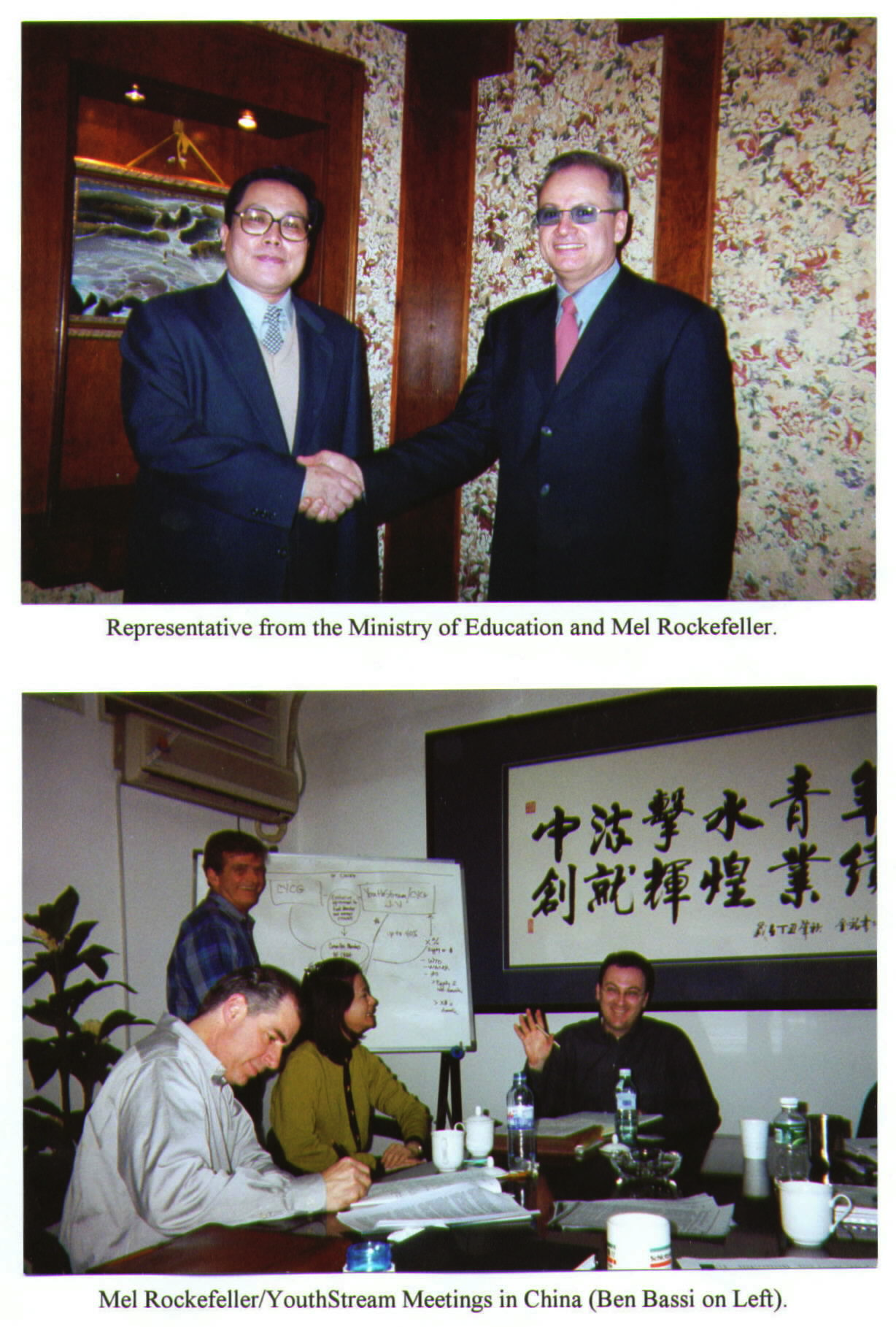
Two days later, Ben and I adjusted to the Peltz setback and convened a meeting with Deputy Minister of Education Liu Bin with whom we negotiated a memorandum of understanding (MOU) for Youthstream to provide an exclusive Internet education portal for students throughout China. As Minister Liu explained, he had 235 million students under his care and 22,000 “youth palaces” to support after-school study. To protect Ben’s job by ensuring he did not proceed contrary to Harlan’s wishes, the MOU required final approval by Youthstream.

When Minister Liu presented me with a prized 50th Anniversary booklet, he explained that the same gift was presented the day before to former President George H.W. Bush. The gift was stolen from my residence on May 20, 2004, pre-staging a confrontation with Fresno, California police. When the booklet was later covertly returned to my residence, I sent it to the former president at his Houston office.
 What sold the Minister on our plan was how it protected shareholders in the 21st century, including their intellectual property (IP). To make the point, I asked, “How much are you stealing each year in Microsoft IP?” Without hesitation, he replied, “Two billion dollars.” I then asked, “Minister, when we scale the model and recycle two-thirds of savings to stakeholders with education our long-term partner, who then will you be stealing from?” His eyes became very wide, and he said, “We will be stealing from the stakeholders who, with your model, will be Microsoft’s partner.”
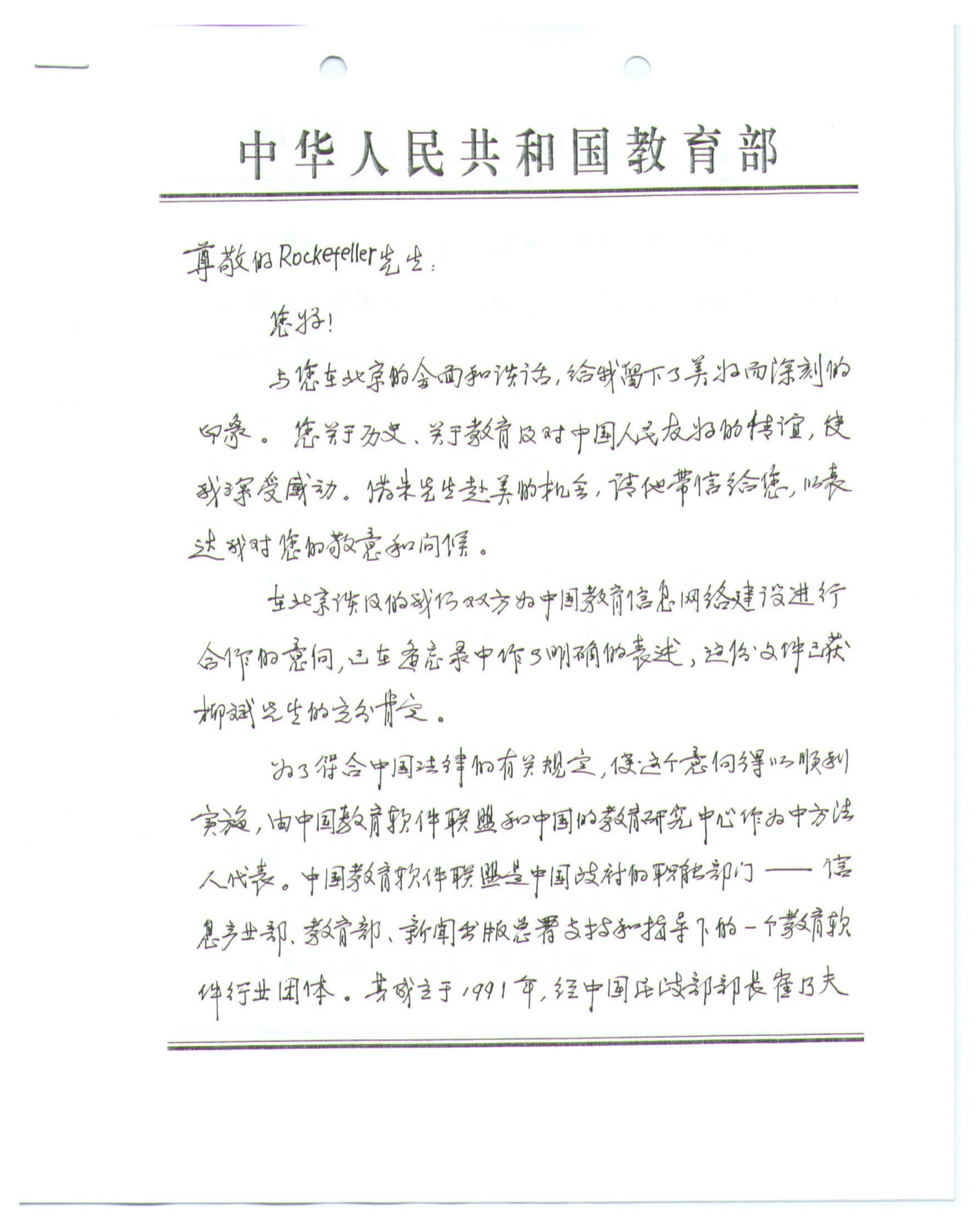
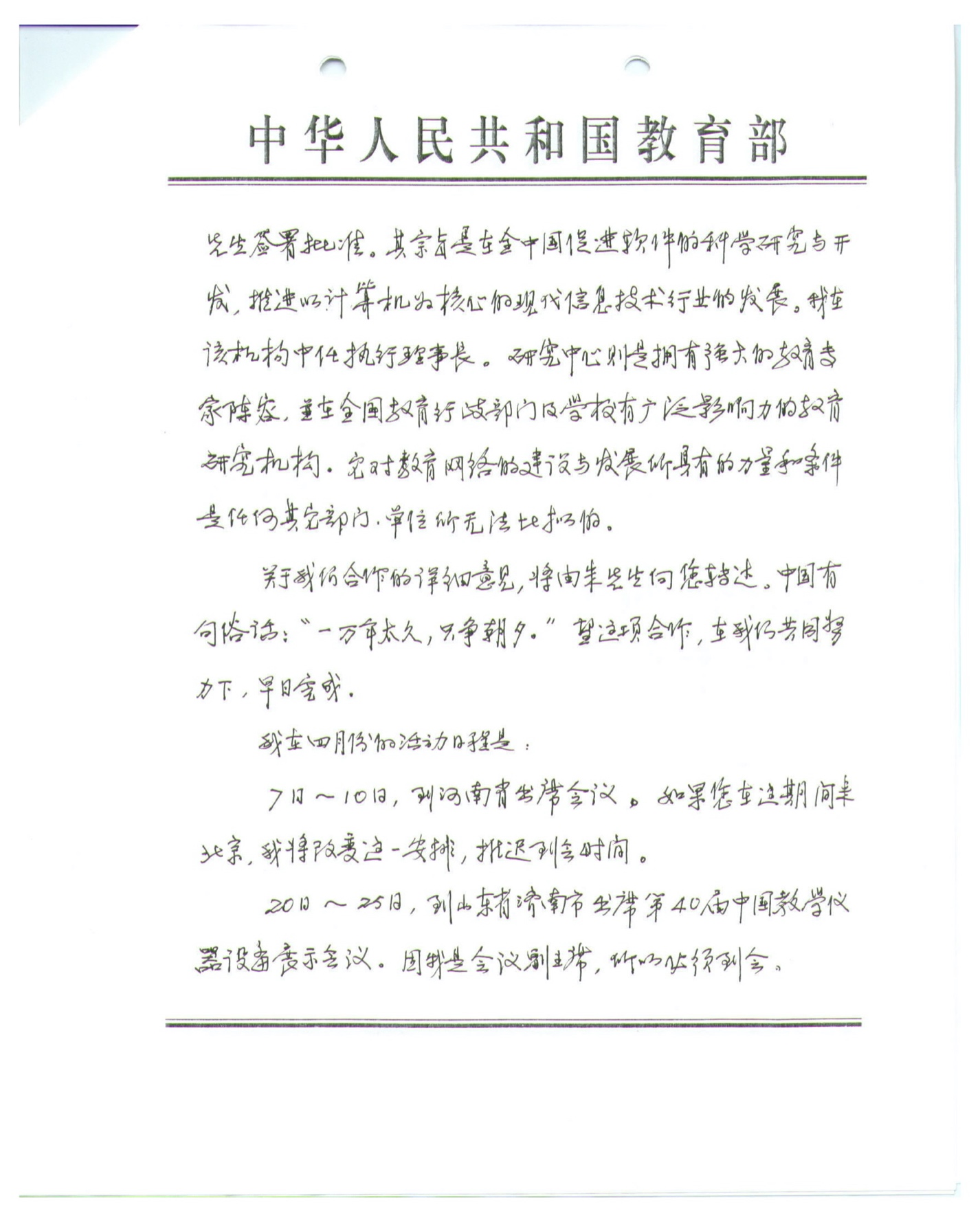
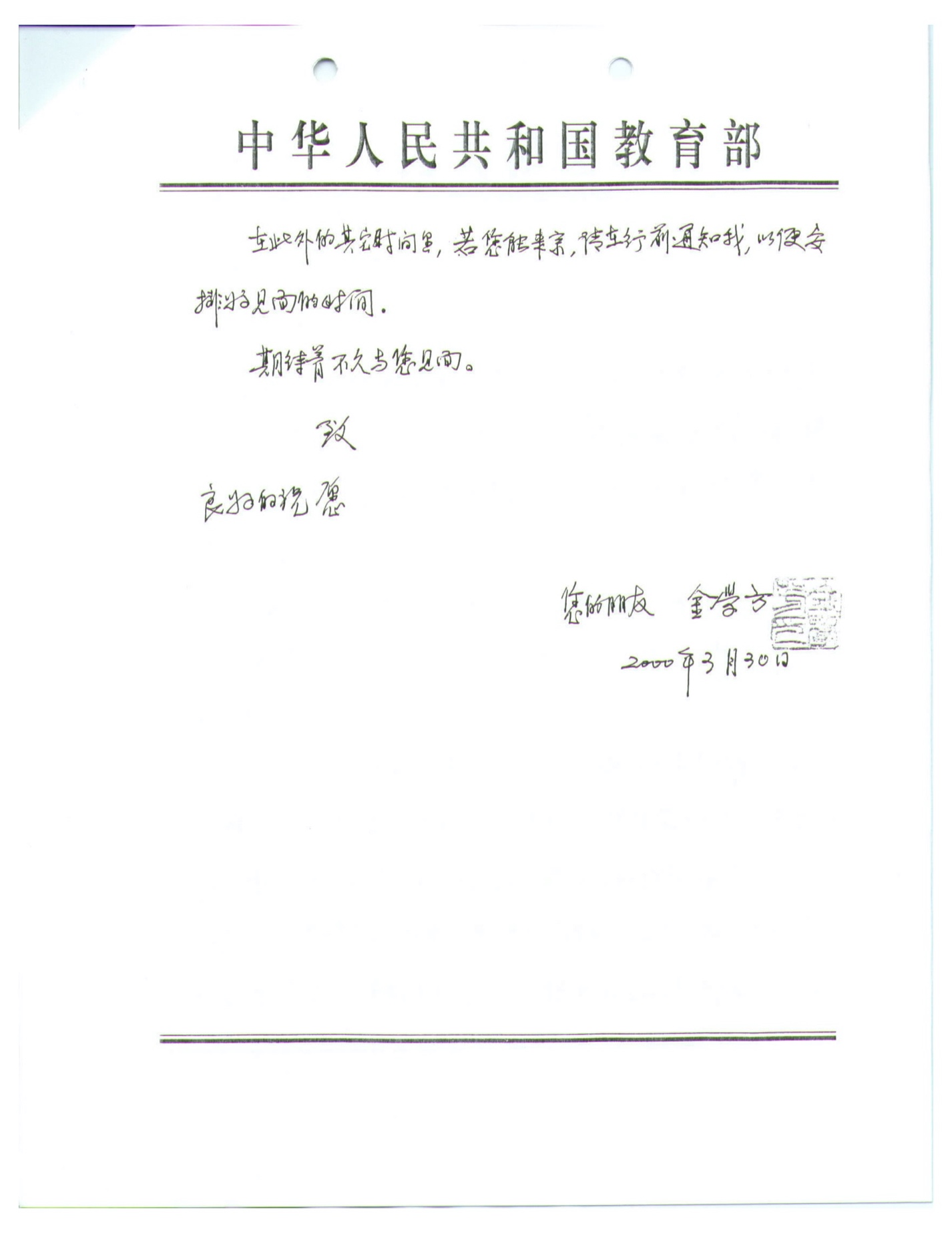
We closed the meeting and had a signed MOU the next morning. When I called Glenn with the news, he described the agreement as historic, including the rapid turnaround for approval by a bureaucratic government known for delays. When Dennis Lou saw the quality of the calligraphy I was presented along with the respectful terminology, he agreed it was historic. The original of that beautiful document was stolen from my home though a photocopy was retained (see below).
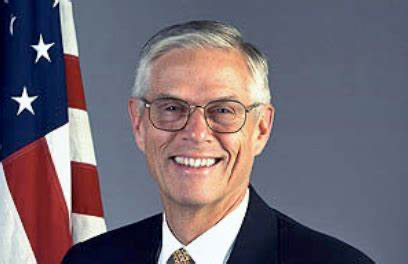
At Glenn’s urging, Ben and I contacted the embassy to schedule a courtesy briefing for U.S. Ambassador Joe Prueher whose schedule was full. The next day, soon after Ben and I took our seats in the First-Class cabin for our flight home, we saw a delegation of Chinese come aboard to help seat a couple near us. As we prepared for takeoff, Ambassador Prueher said he recognized us from the photos that accompanied our request. He urged that we convene in the lounge for what became a three-hour discussion.
As we explained our education-centric business model, the ‘first screen’ on computers throughout China (including in 22,000 youth palaces) would show how much companies contribute to education, enabling the model to capture for education an estimated 70 cents of every advertising dollar being spent by companies in China (then ~$1.3 billion). The Education Ministry saw that our “pull through” marketing expanded their modest budget at a time when Microsoft’s “push” marketing alone was $700 million. With our agreed-to Internet model, stakeholders would become virtual partners, reducing risk by aligning interests—a primary risk management feature in the NewRock approach to business.
Parents would know in real time which companies were recycling profits to provide their children with a life their parents never had. As I explained to Admiral Prueher, my father pioneered this hybrid model in the 1940s but lacked the technology, including the inclusive financial technology, now available to implement the model—at scale.
 Education, Culture and Discretion
While we worked out our agreement in Beijing, Glenn Olds arranged for us to partner with 14 major universities worldwide, including the University of California system, S.U.N.Y. and others. The value of what China agreed to in 2000 would have delivered far more financial value than Alibaba. The designed-in systemic benefits (educational, social, fiscal, etc.) would have generated even greater value.
Future revenue modeling will prove this to be the case with China now forced to confront rampant corruption and an fast-widening inequality that would not have become as systemic had our transparent stakeholder-inclusive model for China not been undermined by Israeli interests in 2000.
When I first met the Minister of Education, he asked my opinion about the insistence of Clinton trade negotiator Charlene Barshefsky that all Hollywood movies be allowed into China regardless of content. Prior to our meeting, I was told by our senior PLA handler not to mention Jews or Israel.
As we sat down to take the official photographs and begin our discussion, the Minister immediately asked me on behalf of his boss, the person in charge of content nationwide, “Why are all U.S. trade negotiators Jews and why do they demand that China give Hollywood free access to show in China whatever films they desire—with Hollywood controlled by Jews? We have concluded all of our trade talks except for the issue of how many films can be imported each year.”[24] In response, I said,
Minister, if you were a guest in my home and you told me what content I must show my children, I would throw you out of my home! China is your home. You have 235 million children for whom you’re responsible. Tell Ms. Barshefsky that many American homes are far more totalitarian in censoring what their children watch on television due to the disconnect with Hollywood and the destructive impact of their content on the impressionable minds of our youth with gratuitous violence, the degradation of women, rape, and brutally graphic content.
Our Founders did not anticipate such abuse of our First Amendment by those abandoning discretion. This is a very real issue for tens of millions of American families who censor what their children watch. Tell Ms. Barshefsky to have Hollywood produce films you deem healthy for your children and there’s no problem importing whatever they wish. Until then, you will continue to screen and censor what they’re producing and, if she has a problem, throw her out of your home.
The minister looked at his translators to ensure they took accurate notes of our conversation. One of them pulled a recorder out of his pocket to confirm they had. The Minister was clearly happy they had a record of what was said.
Transnational Corruption
When Harlan Peltz undermined our deal in Beijing, he also locked up Youthstream shares held in Ben Bassi’s name, then valued at $62.5 million. Ben and I later confirmed that Youthstream Chief Financial Officer Bruce Resnick sold $20 million in Youthstream shares just prior to Peltz nullifying our successful negotiations.[25] Because I found a way to close the deal, Ben was fired enroute home from Beijing with “P.T.” Lucceshi replacing him as president.[26]
 Peltz and Lucceshi later met with Kaisa Kautto-Koivula, senior executive at Nokia Ventures, the $14 billion investment arm of the Finnish firm that committed to finance our education portal agreed to with Minister Liu. Nokia was then the world’s largest manufacturer of cellphones and the top two largest handset providers in China. After I described the NewRock model, I explained to Kaisa that the real value of the cellphone was not the technology but the content that would drive its design and utilization.
 Steve Jobs understood that key distinction, as shown by the Apple iPhone with its accommodation of a vast array of applications (apps) and its subsequent domination of what soon emerged as the smartphone market.
When Peltz blocked us in China, Kaisa and I were prevented from proving what Apple since has proven. Nokia had an opportunity to take their handsets from a commodity to a widely used smartphone in the world’s largest market. Also, the model would have associated the Nokia brand with an online business model that recycled advertising dollars to education rather than, as now, amassing enormous wealth almost solely for the founders of Alibaba, Tencent, Facebook, Google, Amazon, Twitter, etc. Plus the model would have enabled Nokia to partner directly with communities, providing a designed-in competitive advantage that other firms could not easily adapt to meet.
Though Ben and I were excluded from a subsequent meeting with senior YouthStream executives, Kaisa confirmed Nokia’s willingness to proceed with our plan by making an all-cash offer to acquire the firm provided YouthStream honored my contract. When Peltz declined the offer, that decision confirmed for senior Nokia executives that I was being criminally stalked. That decision also left Nokia without a means to access the world’s largest smartphone market. In 2022, China had 1.7 billion mobile phones; 68 percent (975 million) were smartphone users.
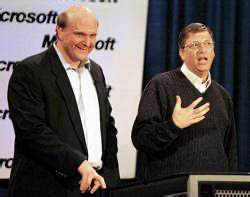
The Nokia division best positioned to prosper with our model instead began its steady decline as Apple raced ahead and Nokia fell ever further behind. A month after Microsoft CEO Steve Ballmer announced his retirement, he oversaw the acquisition of Nokia’s smartphone division, the last of his many strategic blunders. In July 2015, his successor as CEO declared that acquisition a $7.8 billion mistake, putting 7,800 Nokia jobs at risk as those stalking me imposed a hidden tax on the Finnish economy.[27]
Corruption of Education
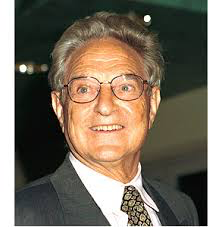
 I first met Kaisa in Tampere when Glenn Olds asked that I attend a conference on distance education due to his concern that George Soros would undermine the project. By then, Glenn was confronting the reality that Soros money was being used through his Open Society outlets to seed outcomes contrary to their stated goals.[28] Kaisa had me fly to Helsinki where we spent two days preparing and polishing three 10-minute presentations to close $50 million from each of three Nokia divisions to cover the initial $150 million that Nokia committed to back me in China. Kaisa began working with Nokia in her teens when the company manufactured boots for the Russia army.
As we finished our presentations, she asked that everyone leave the conference room. She closed the door, turned her chair toward mine and asked that I turn my chair to look directly at her. With her face two feet from mine, she said,
Mel, due to the importance of Nokia to the Finnish economy, the board ordered a background check on you. Based on your family name and the circumstances of your life that you shared with us, we had Finnish intelligence do a complete work-up on you for review by our CEO and board. China is very important to our future. In summary, the report said to back you and that you had real vision. One section stated that you were being actively stalked by a foreign government. When our CEO Jorma Ollila asked that they explain this section, they refused and told him that portion was classified. Ollila and two of our senior board members wanted me to ask you what this is about.
I looked directly at her and said, “Israel is the government. Their motive is the assassination of President Kennedy that I unknowingly connected myself to while looking for my father.” Without saying a word, she stood up and walked out. I thought for sure I had blown the deal but felt good about it as I had followed my maternal grandfather’s advice to always tell the truth even when it’s most difficult.
 A driver took me back to the Kämp Hotel where I began packing while the concierge changed my departure flight. I could not stick around believing I had wasted a year’s work. Twenty minutes later, Kaisa called and told me she would pick me up for dinner. When she arrived, she jumped out of the car, hugged me, and said,
Mel, I had to walk out without saying a word to you, ensuring I conveyed your precise words and facial reaction to those who requested that I ask you those questions. I told them and they all agreed with me that we must back you. We know you’re being stalked and if it is who you believe it is and their motive is that they are the true murderers of President Kennedy, we all agree you were willing to walk away not flinching when asked a question that you never stopped to reflect on before responding. The board concluded that, with that much at stake, for you to answer in that way meant your response was likely true. We want to do business with you and don’t care if you’re correct as to who and why in the classified report.
The Cost of Collaboration
Bill Townsend, then Senior Vice President at YouthStream, was also part of our team in China. When Peltz squashed the deal, he lost $32 million. Bill and I lost touch until 2007 when he contacted me after meeting former YouthStream Chief Financial Officer Bruce Resnick at a social gathering. When Bill asked him what happened at YouthStream, Resnick explained that, although he is Jewish, he was not part of the elite Jews who made up the YouthStream board.
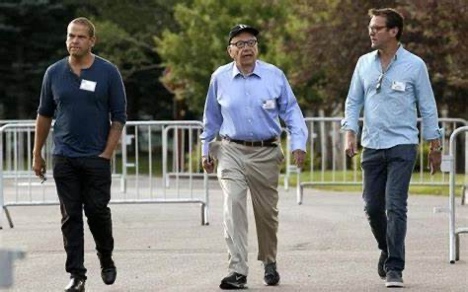
Harlan Peltz was particularly close to Herb Allen who served as his mentor. The Allen Brothers’ annual gathering in Sun Valley, Idaho draws the top media industry executives. As the former executive explained, “I wasn’t part of the circle controlling our stock. I walked into the boardroom with them all there and heard them say they couldn’t let Rockefeller get paid or see the model part of a plan engaged by China’s leadership, empowering China’s youth.”
When Bill called to relay that story, he asked why I had not told him I was being stalked, by whom and why. My response, “Would you have believed me?” He replied, “No.” When Bill agreed to work with me again, he was fired from a job paying $500,000 per year when their (Jewish) executives discovered we were again collaborating on the deployment of our community-focused stakeholder model. A serial entrepreneur and enormously talented, Bill remains one of the few people who has hung in as everyone around me—including people around them—was targeted, often financially.
Two weeks after Jeff interviewed Ben Bassi in October 2003, Ben was fired from Liquid Machines, Inc., a Lexington, Massachusetts firm where he was senior vice-president for sales. His dismissal reportedly came as a surprise both to Ben and his colleagues. Frightened and reluctant to talk, Ben described how he also became the target of a multi-year tax audit by the Internal Revenue Service.[29] Expressing similar concerns, Kaisa requested of Jeff in December 2004 that we defer any further contact with her until these matters are functionally engaged by our national security agencies. We’ve respected her request. And continue to await that engagement.
 The People in Between
On a December 1999 flight from San Francisco to Tokyo, I was assigned a seat next to Elaine La Roche, CEO of China International Capital Corporation (CICC), an investment banking joint venture in which Morgan Stanley owned a 35% stake.[30] We talked during the entire trip. When we were again seated next to each other on the Tokyo to Beijing flight, she commented that someone must have arranged for me to sit next to her. I corrected her, “No, someone arranged for you to sit next to me.” After hearing my earlier explanation of this work, she agreed and invited me to dinner in Beijing.
 After my March 2001 meetings in Jakarta with Indonesia Intelligence Chief Arie Kumaat, who agreed to champion our model in the region,[31] I asked Elaine if she would serve as CEO of a region-wide education and tech-transfer venture in Indonesia similar to what Dr. Olds and I designed for Iraq (that Munther Ghazal and I proposed while in Baghdad in 1997) and what Ben Bassi and I successfully negotiated in China in 2000. In response to her expression of interest, I sent her a package of materials.
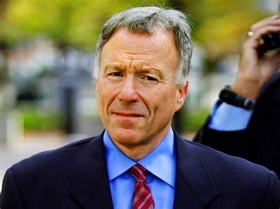
Between the time I sent the materials and when I called her, Vice-President Dick Cheney sought to recruit her as senior executive of the Manila-based Asian Development Bank (ADB), a regional counterpart to the World Bank. As she explained, “Mel, after we spoke, Dick Cheney phoned the next day asking me to take over the ADB. I told him I had other commitments. You and Arie get done what you need and I’m all in. The timing of his call convinced me.” Vice-President Cheney may well have been advised on the timing of this offer by his chief of staff, Jewish-neocon Lewis “Scooter” Libby, in collaboration with others to be identified who were complicit in “fixing” the Iraqi WMD intelligence that induced the U.S. to wage an unnecessary and unwinnable war.
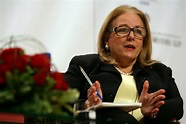
Following Arie’s murder in January 2002, Elaine opened Passports, an Asian antique store in Salisbury, Connecticut and reengaged CICC in a senior advisor role. While in China, I was able to confirm how much the Chinese trusted Elaine and how much they distrusted Jewish bankers and investment bankers in New York. They refused to have anything to do with them. Elaine died in 2019.
China preferred our mindset and our model that would by now have recycled trillions of dollars in wealth and income to education and vocational training rather than concentrating IT-derived wealth and income in the hands of a few. With today’s “consensus model” approach, banks and investment bankers collect fees for structuring suboptimal transactions and achieving suboptimal outcomes.
What I proposed for China, Iraq, Indonesia and El Salvador—combining tech transfer, education and vocational training—has since emerged as the industry standard for learning design for those active in IT-enabled education and training.[32] The missing piece is the stakeholder-inclusive hybrid business model, including a self-financing component designed to incentivize personal responsibility with bottom-up accountability and transparency—while bridging the public-private divide where corruption is enabled by the current consensus. We designed our way into this; we can design our way out.
Exhibits:
- Photos in Beijing (2000)
- Calligraphy
Endnotes
- Each of the three Nokia divisions committed an initial $50 million with an additional $100 million assured based on terms to be set in conjunction with YouthStream Media Networks. The agreed-to plan envisioned the use of low-cost injection-molded “smart desks” with one Nokia division providing the flat screen, another the wireless connectivity and the handset division adapting to provide the content-management component that Steve Jobs foresaw with Apple’s design of the iPhone. With our Dutch partners at Open University, pioneers in the meta language that has since become the global standard for online learning, we could show how to scale education beyond the classroom to include vocational training, adult education and the ongoing re-education essential in the transition to the Knowledge Society. By demonstrating how to generate system-wide savings as the classroom model scaled with the Ministry of Education, we could sell the solution once and have the model sell itself as measurable cost-savings provided a pull-through without the need for any marketing. That strategy enabled us to scale the solution without the need for outside capital. Instead demonstrable savings became our capital to fund the build-out as a community-centric model monetized the savings and the value-add for community. With a bottom-up approach that, by design, eliminated the middleman (see Chapter 8 re “the people in between”), I was able to adapt the model deployed by my great-grandfather to displace those who have long imposed a hidden tax on humanity. Thus their need to interfere knowing the model could be replicated worldwide. ↑
- National Archive officials confirmed at the time that they could not know for certain which documents he destroyed. That contemporaneous account has since been altered to suggest that copies were stolen rather then the originals as initially reported. In his defense, Mr. Berger was represented by Lanny Breuer who was appointed head of the Criminal Division of the Department of Justice in January 2009. Prior to his March 1, 2013 departure, Mr. Breuer stated that the lack of prosecution for wide-ranging Wall Street fraud was due to a lack of evidence sufficient to meet the evidentiary standard of proof beyond a reasonable doubt required for criminal culpability. Echoing the views of Attorney General Eric Holder, he also conceded a reluctance to prosecute large banks for fear that an indictment, “will have a negative impact on the national economy, perhaps even the world economy.” The New York Times, March 12, 2013. ↑
- See Chapter 2 describing documents hand-delivered to the 9/11 Commission on April 12, 2004 that included the facts and analyses in The Hidden Tax on Humanity. Though more than 1,200 witnesses were interviewed, no one contacted me, my counsel Ron Burd or Jeff Gates who hand-delivered the documents and had them signed for addressed to Chairman Tom Kean, Vice-Chairman Lee Hamilton and Executive Director Philip Zelikow. ↑
-
Daniel Ren, “China produces 182 new billionaires, triple the new faces in the US”, South China Post, February 20, 2020.
- Figures are according to the Hurun Report that tracks wealth in China. For the number of U.S. billionaires and the pace of billionaire creation in China, see Pamela Ambler, “Asia Is Now Home To The Most Billionaires, With China Leading The Pack,” Forbes, October 30, 2017.
- Future research will identify how actress Jiang Qing, Mao’s fourth wife, came into his life to emerge as a leader in the Cultural Revolution and, after his death, a leading member of the Gang of Four responsible for the civil unrest that contributed to the death of millions of Chinese from politically sanctioned abuse and hunger. ↑
- “Driving the Rockefeller Legacy in China,” December 15, 2014. http://www.wealthx.com/articles/minisite-post/carrying-on-the-rockefeller-legacy-in-asia/
- “The Return of Mao,” Financial Times, October 1-2, 2016.
- Paul Ross, “Mao’s Jews,” Jewish Journal, November 20, 2015. ↑
- One of the key remaining family legacies from that era is Peking Union Medical College, widely considered the best medical school in China and an institution affiliated with Tsinghua University, one of China’s top universities. ↑
- “Command and Control,” Financial Times, July 27, 2016, p.7. ↑
- Laura Goldman, “A Jew in Mao’s China,” Forward, July 9, 2012. ↑
- Mr. Wang served five years as the powerful head of the Central Committee for Discipline Inspection and remains a powerful figure. See Choi Chi Yuk, “Premier Li Keqiang has the spotlight but Wang Qishan is the centre of attention,” South China Morning Post, March 5, 2018.
- Chris Buckley, “Xi Begins Term With a New No. 2 to Tackle Trump,” The New York Times, March 18, 2018. ↑
- The term comrade faded from use in the 1980s along with the Mao jacket. An October 2016 meeting of the Communist Party’s Central Committee issued a directive instructing party members to call each other comrade. In recent decades, the once ubiquitous term has been widely used to describe gay men and women. Amy Qin, “’Comrade’ Xi And a Title Turned Gay,” The New York Times, November 16, 2016,
- The Jewish Institute for National Security Affairs (JINSA) boasts that advisory board member Stephen Bryen served for eight years as a Reagan-era Deputy Under Secretary of Defense where he founded the Defense Technology Security Administration and served as its first director. Bryen then served on the Government Security Committee of Space Systems/Loral. Loral shareholders (i.e., neither Schwartz nor Breyer) were ordered to pay a $20 million fine for undermining U.S. national security. In practical effect, that fine was paid largely by pension plans holding Loral shares. China’s relatively low-tech missiles are now routinely sold for use in conflicts worldwide. Charles Clover and Sherry Fei Ju, “Beijing’s missile makers cash in on small wars,” Financial Times, October 28, 2016. ↑
- Chris Buckley, “For China’s ‘Core Leader,’ Status Laced With Anxiety,” The New York Times, November 2, 2016, p. A4. ↑
- Chun Han Wong and Eva Dou, “Foreign Companies in China Get a Partner: the Communist Party,” The New York Times, October 29, 2017. ↑
- For the deficit-financed source of the cash flow that enhanced the viability of leveraged buyouts with the enactment of Reagan-era deficit-financed “supply-side” economics, see Chapter 6 of Guilt By Association: “Money, Democracy and the Great Divide.” Harlan Peltz was also a core shareholder in Traffic Station, a firm founded by Barry Weingart and Geoff Halstead that succeeded Alpha Base Interactive which, in turn, succeeded Alpha Base Systems, a firm in which Weingart I were two of the three principal shareholders until Weingart defrauded me of my equity, aided by my (Mormon) attorneys and a compromised Los Angeles Superior Court Judge. Harlan boasted that World Bank President Jim Wolfensohn was also a close family friend due to his mother, Lauren Veronis, who married John J. Veronis of media merchant bankers Veronis, Suhler, Stevenson. With the help of Drexel Burnham Lambert junk bonds, his father Nelson Peltz and Peter May acquired National Can in 1985 for $460 million, one of the first takeovers using high-yield, non-investment grade debt securities (“junk”). After a series of acquisitions, Peltz and May sold Triangle Industries, their acquisition vehicle, for $1.26 billion plus the assumption of $3 billion in debt, generating a 120% annualized return over five years. Along the way, they acquired Snapple from Quaker Oats for $300 million, selling it three years later to Cadbury’s for $910 million, plus $540 million to cover assumed debt and employee options. In July 2004, Peltz and May acquired Deerfield & Company, an investment firm that manages $8.1 billion for pension funds and institutions. Chicago-based Deerfield also manages $700 million in hedge funds, an area into which they announced their intent to expand. Peltz has a July 2020 personal wealth of $1.7 billion according to Forbes magazine. See Riva D. Atlas, “Successes Past, Partners Seek Next Big Deal In New Venue,” The New York Times, July 31, 2004, p. B1. Peltz then started a hedge fund, Trian Fund Management, to pursue “operational activism.” In mid-2006, he emerged as a major investor in H.J. Heinz where he argued that cost cuts, the sale of non-core assets and better marketing could double the company’s value. James Politi, “Peltz presses Heinz to raise efficiency,” Financial Times, May 24, 2006, p. 18. In September 2006, Peltz and Michael Weinstein, former CEO of Snapple, won seats on the Heinz board. Sean D. Hamill, “2 Dissidents Appear to Have Won Heinz Seats,” The New York Times, September 9, 2006, p. B3. Heinz confirmed their seats September 15, 2006. In July 2015, he lost a proxy battle at DuPont and, in November 2015, increased his stake. In July 2017, he launched a proxy campaign against Procter & Gamble, gaining a seat on its board as P&G increased its board by two to 13. “P&G appoints Peltz to board despite losing proxy battle,” CNBC.com, December 18, 2017.
- Simon Rifkind represented AIPAC since its inception dating from when it morphed into its current form from the more honestly titled American Zionist Council. For the role that Rifkind played in enabling AIPAC to operate outside federal law and avoid registration under the Foreign Agents Registration Act, see Grant Smith, America’s Defense Line (2008) and Big Israel—How Israel’s Lobby Moves America (2016), Washington, D.C.: Institute for Research: Middle East Policy, Inc. ↑
- Charles F. Goldsmith, then a Paul, Weiss lawyer in Beijing, was also involved with this client. ↑
- From 1927 to 1933, Simon Rifkind served as legislative secretary to New York Senator Robert F. Wagner, father of Mayor Robert F. Wagner. He served as a Federal District Court judge in New York from 1941 to 1950 when he joined Paul, Weiss, et.al. In October 1945, the War Department, at the urging of General Dwight D. Eisenhower, appointed him chief civilian adviser on Jewish affairs in Europe to General Eisenhower where he championed the creation of Israel. That role led President Harry Truman to award him the Medal of Freedom. He died in November 1995 at age 94. ↑
- The same year as the founding of Israel, Texan Lyndon Johnson won the 1948 Democratic primary in a Democratic state by an 87-vote margin with 200 of those votes tallied in alphabetical order. Abe Fortas served as his counsel in successfully defending this election fraud in a lawsuit brought by Coke Stevenson, a popular former Governor of Texas. In October 1965, as president, “Landslide Lyndon” appointed Fortas to replace Arthur Goldberg on the Supreme Court after persuading Goldberg to serve as U.N. Ambassador. A scandal thwarted LBJ’s attempt in 1968 to appoint Fortas as Chief Justice to succeed Earl Warren. An outspoken Zionist, Fortas hosted a small dinner party at his home the night of June 4, 1967 for New York investment banker John Loeb (of Lehman Kuhn Loeb), President Johnson and Defense Secretary Robert McNamara. The Fortas/Loeb dinner confirmed that neither Johnson nor McNamara knew Israel would launch a war 5-1/2 hours after LBJ left the party. By then, former Irgun operative Mathilde Krim had struck up an affair with America’s Commander-in-Chief and was his sleepover guest at the White House that same night. When informed of the war, before telling anyone else, LBJ stopped by Mathilde’s bedroom to tell her, “The war has started.” Only three hours later, at 7:45 a.m., did Johnson speak with Soviet Premier Kosygin who expressed his hope and expectation that the U.S., as Israel’s closest ally, would restrain Tel Aviv in its aggressive taking of land belonging to its neighbors. That war, planned since 1951 according to an Israeli general (former Israeli Prime Minister Menachem Begin conceded there was no threat), ensured an ongoing provocation whose game theory model-able results continue a half-century later. Rebranded as an HIV/AIDS activist working with Hollywood’s elite (e.g., Elizabeth Taylor), Bill Clinton awarded Mathilde Krim the Medal of Freedom in August 2000 as one of this asset’s last acts as president. She died in January 2018. ↑
- “Jews totally run Hollywood.” See Joel Stein, “Who runs Hollywood? C’mon,” The Los Angeles Times, December 19, 2008. ↑
- By January 2000 the Rupert Murdoch-controlled News Corp. reportedly had become an investor in YouthStream and was looking forward to “exploring ways to deepen its relationship with YouthStream.” “A Way To Woo Youth,” Newsweek, January 24, 2000. ↑
- Bassi notes that the merger of his small company (Commonplaces) with YouthStream was finalized by board action the same day he and I left for Beijing, excluding Ben from decision-making and leaving him on his return with no lines of authority in his old firm. ↑
- “Between the time the Nokia deal was signed in February 2011 and the acquisition announcement in September 2013, Nokia’s global market share of handsets fell from 25% to less than 5%, according to data from Statista. In other words, Ballmer persuaded Microsoft to drop over $7 billion on a ‘declining asset’ as Microsoft’s CFO once described Yahoo after Microsoft walked away from that attempted acquisition in 2008.” “Satya Nadella just undid Steve Ballmer’s last big mistake,” Business Insider, July 15, 2015. In May 2016, Nokia announced an agreement to begin making handsets again under a global licensing deal. “Nokia brand set for mobile phone revival,” Financial Times, May 18, 2016. By late-2017, the firm had announced the release of a new line of mobile smartphones. ↑
- Glenn was worried about a relationship between Soros and Takeshi Utsumi, an innovator in telecommunications, founder and vice president for technology and coordination of Global University System, and 1994 Laureate of the Lord Perry Award for Excellence in Distance Education. His innovations in distance learning included multipoint-to-multipoint multimedia interactive videoconferences using hybrid technologies. ↑
- In January 2001, Business Week reported that Rupert Murdoch’s News Corp. became an investor in YouthStream when Peltz acquired sixdegrees.com in which Murdoch was a major investor. We since found that Ben Bassi was reportedly paid $1 million in hush money to ensure the Bill and I did not have his cooperation in approaching the Securities and Exchange Commission and the Justice Department to investigate this fraud on YouthStream investors. ↑
- China Construction Bank owned 42.5%. As the first approved investment bank in China, CICC earned $261 million in underwriting fees in 2000 for the launch of China Unicom, PetroChina and China Telecom (now China Mobile Hong Kong Ltd.). Morgan Stanley’s prospects were improved by a junior managing director who, as a son of then-Premier Zhu Rongji, persuaded the Chinese government to decontrol oil prices. CICC also sold $200 million in bonds for construction of the Three Gorges Dam.
- See Chapter 3, “The Indonesia Connection”. ↑
- I also collaborated on this project with Fred de Vries, a pioneer in distance education at Open University of the Netherlands. See “Open University of the Netherlands – Educational Technology Expertise Center.” ↑
